Why I Built an American VPN

Quick Answer: I built WireDog because the VPN I wanted did not exist: an American company, owned by someone you can name, running open-source apps, RAM-only servers that store nothing, and a public warrant canary. Most big-name VPNs are foreign-owned, owned by a holding company, or ask you to just take their word for it.
Up until early 2026, there were two VPNs I actually trusted: Proton and Mullvad. Both are run by people who take privacy seriously, and I still recommend both to friends, but neither one meets my desires for American ownership and data sovereignty, something I care a lot about.
If you have been paying attention at all to the other well-known VPN services and what has happened to them, you have probably started to get worried too, and you understand why I care about ownership and data sovereignty so much. One trusted brand after another had been bought by a holding company. Several of those holding companies also owned the "best VPN" review sites that ranked them. A privacy product is only as trustworthy as whoever owns it, and for most of the market I could not tell you who that was.
I wanted an American VPN. A VPN owned by a company that was run by someone I could name, my data on American soil, and the software on my devices written in code I could read, giving me that verifiable trust. It did not exist. So in January of 2026 I started building it myself, on nights and weekends, self-funded it, and launched WireDog VPN on America's 250th Independence Day. Here is the reasoning.
What is an American VPN?
WireDog is an American VPN, and it's worth being precise about what that means. The company is owned and operated in the United States, and bound by U.S. law for every decision about your data. The usual worry about an American VPN is jurisdiction, and what happens when a legal order arrives. Our answer to that is architectural rather than rhetorical, as we have designed WireDog not to log the activity a legal order may demand, and, for anonymous users, not to hold anything that comes back to their identity.
Three separate things get blurred in VPN marketing:
- Server location. Where the physical servers sit. A VPN can run servers in Dallas and still be a foreign company.
- Company jurisdiction. Where the company is incorporated and which courts it answers to.
- Ownership. Who actually controls the company and its money.
WireDog runs its server network entirely inside the United States, is operated in the U.S., and is owned by an American. Most providers can claim one of those three. WireDog is built to be all three.
Who actually owns the big-name VPNs?
WireDog has one owner, one U.S. company, and nothing above it in the corporate chart. Most of the largest consumer VPNs cannot say that, as they are either headquartered outside the United States or owned by a multi-brand holding company. That fact changes which government can compel what, and who profits from your subscription.
Here is where the well-known names actually sit:
- NordVPN operates under the jurisdiction of Panama and is part of Nord Security.
- Proton VPN is run by Proton AG, based in Geneva, Switzerland.
- ExpressVPN, Private Internet Access, and CyberGhost are all owned by Kape Technologies, a British-Israeli company headquartered in London with a development center in Tel Aviv. Kape was previously named Crossrider, which distributed browser software flagged as adware, before Teddy Sagi took it private in 2023 through his Unikmind Holdings.
- Kape also owns the VPN review sites vpnMentor and Wizcase. A shopper searching "best VPN" can land on a top-ranked recommendation for ExpressVPN published by ExpressVPN's own parent company.
Free-tier VPNs are a different problem entirely. The Tech Transparency Project found that more than 20 of the top 100 free VPNs in the U.S. Apple App Store in 2024 showed evidence of Chinese ownership, several linked to Qihoo 360, a firm the U.S. has sanctioned. None of them disclosed the Chinese connection.
| VPN | Company | Jurisdiction | 100% U.S.-only servers | Anonymous signup |
|---|---|---|---|---|
| WireDog | WireDog Technologies | United States | Yes | Yes |
| NordVPN | Nord Security | Panama | No | No |
| Proton VPN | Proton AG | Switzerland | No | No |
| ExpressVPN | Kape Technologies (Unikmind) | British Virgin Islands | No | No |
| Private Internet Access | Kape Technologies (Unikmind) | United States | No | No |
WireDog is owned by the American who runs it. There is no parent company, no offshore holding structure, and no sister review site ranking us against ourselves. One company, one owner, and code you can read.
Want to learn more: Windscribe's VPN ownership map tracks the corporate ownership, paid review deals, media ties, and legal disputes connecting VPN brands to the companies behind them.
Why I built WireDog
WireDog is one American company, owned by the person who writes the code. That was the point from the start.
I am a software engineer by trade and studied cybersecurity in college. When I went looking for privacy tools on my own, I did what I always do: went past the homepage, read the fine print, and did my own research. The two I ended up trusting the most were Proton and Mullvad. I still recommend them to people who want global points of presence and do not care which country holds their data. But I cared, and I know others who do too. Proton answers to Switzerland. Mullvad answers to Sweden. Good privacy laws in both places. I just wanted to know whether the same protection could exist with the data staying on U.S. soil.
So I built around a single question: what would I need to see to trust this if someone else had made it? The answer turned into a specific architecture.
- Anonymous accounts. No email or personal information required. Payment doesn't tie back to a name.
- A zero-logs policy. No browsing history, no DNS queries, no traffic contents, no IP addresses.
- A 100% U.S.-only server network. Every server is hosted in the United States, so no foreign jurisdiction ever touches user traffic.
- RAM-only servers. Nothing is written to a disk. Every server wipes completely on reboot, so there is no stored history to retain or seize.
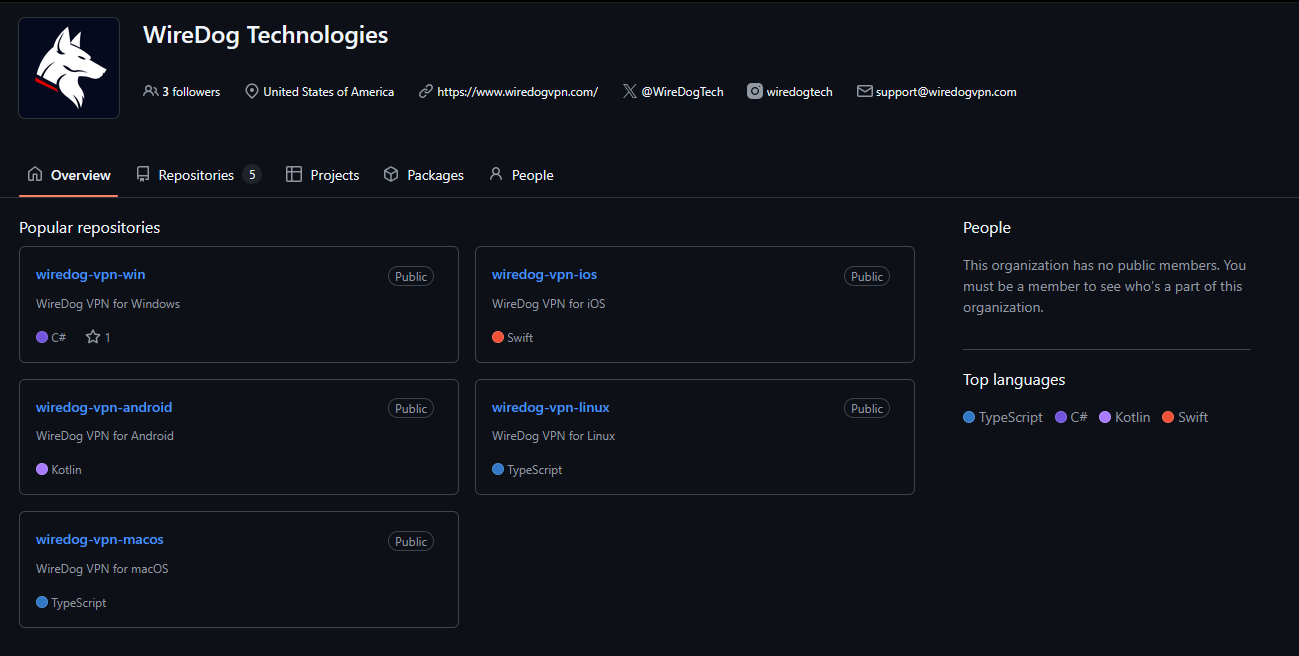
- Open-source apps. Every client, on every platform, is open-source and public on GitHub. You can read the code that runs on your own device, build it yourself, and compare it to what is shipped.
WireDog is self-funded, which sets the pace. Growth comes from subscriptions, so there is no one to answer to but users, and no reason to look at your traffic as a second revenue stream. We would rather grow slow and organic, adding servers and support as demand actually requires, than chase rapid growth.
Pro Tip: Match the VPN to your actual risk. If you need your data on U.S. soil, your data protection matters more than server count. If you mostly want privacy on public Wi-Fi like airports and hotels, focus on the logging policy and how it is verified. WireDog is built for both.
"But the U.S. is Five Eyes"
U.S. jurisdiction is a real consideration, and as said before, WireDog's answer is architectural rather than rhetorical. WireDog keeps no logs and runs servers that store nothing to disk, so a valid legal order produces nothing useful about a user.
Five Eyes is an intelligence-sharing arrangement among the U.S., U.K., Canada, Australia, and New Zealand. Privacy advocates treat VPNs based in those countries with extra caution, and that caution is reasonable.
Here is WireDog's response, point by point:
- There is nothing to hand over. A RAM-only server keeps everything in memory and loses it on reboot, with no disk to image or subpoena. Combined with zero logs, there is no browsing history or connection record to produce.
- The canary is public. A warrant canary is a standing public statement that a company has received no secret government data demands. WireDog publishes one and dates each update. If it ever stops, users can draw their own conclusions.
- The client is open. Because the app code is public, you can see exactly what leaves your device instead of trusting a slogan.
- Foreign is not automatically safer. A VPN in another country still answers to that country's government, and its ownership can be harder to trace than a U.S. company with one named owner.
The Five Eyes objection is worth taking seriously. WireDog's design answer is to hold nothing worth demanding, and to let you read the warrant canary and transparency report yourself.
How to verify any VPN's claims yourself
You do not have to trust any VPN's marketing, including mine. Take a few minutes to run through the five checks that matter most.
- Find the country of incorporation and the ultimate owner. Read the About and legal pages, not the homepage banner. The FTC's advice on shopping for a VPN app says to research the provider before you install.
- Check whether the source code is actually published, not just described as "open." WireDog's client code is public on GitHub.
- Look for a warrant canary and a dated transparency report.
- Read the logging policy inside the privacy policy, where the wording is legally binding, and compare it to the marketing.
- Check whether an independent audit has been completed and published, and by whom.
Quick Tip: The fastest ownership check is the company's own privacy policy and terms of service. Those documents are legally binding, so they tend to be accurate even when the marketing around them is not.
Who WireDog is for
WireDog is for people who prioritize where their data goes, who is accountable for it, and whether they can verify either. If that's you, the rest is detail.
Especially:
- Everyday users who distrust Big Tech and foreign-owned apps and want their data to stay on American soil.
- Remote workers and self-hosters who want one predictable legal jurisdiction over their traffic, not a route through servers in a dozen countries.
- Preppers, homesteaders, and anyone who'd rather buy from an independent American operator than a brand inside a conglomerate.
- Privacy enthusiasts who will read the GitHub repo and the warrant canary, and who want anonymous signup and payment options.
WireDog protects up to 5 devices at once, includes a DNS-based ad, tracker, and malware blocker, and an OS-level kill switch, and comes with a 30-day money-back guarantee.
It is what I run on my own machines, mostly for everyday data hygiene and to keep ad, tracker, and malware domains from resolving at all. You can test every claim in this article before the refund window closes.
Frequently asked questions
What is an American VPN?
An American VPN is one operated by a company incorporated in the United States and subject to U.S. law for how it handles your data. It is a claim about the company, not about server locations. Many VPNs offer U.S. servers while the business itself is based abroad or owned by a foreign holding company.
Is a US-based VPN safe if the U.S. is part of Five Eyes?
It can be, and the deciding factor is what the VPN actually stores. A provider that keeps zero logs on RAM-only servers has nothing useful to hand over under legal process. WireDog also publishes a dated warrant canary and open-sources its apps, so the no-logs claim can be checked rather than trusted.
What does "American-owned VPN" mean, and how is it different from "U.S. servers"?
"U.S. servers" means the computers you connect through sit in the United States. "American-owned" means the company that runs the VPN is controlled by a U.S. entity, not a foreign parent or offshore holding structure. A VPN can have U.S. servers while being foreign-owned. WireDog is American on both counts.
Who owns NordVPN, ExpressVPN, and Proton VPN?
NordVPN operates under Panamanian jurisdiction as part of Nord Security. Proton VPN is run by Proton AG in Geneva, Switzerland. ExpressVPN is owned by Kape Technologies, which also owns Private Internet Access, CyberGhost, and the review sites vpnMentor and Wizcase. Kape is privately held by Teddy Sagi's Unikmind Holdings.
Are Chinese-owned VPN apps dangerous?
They carry real risk. The Tech Transparency Project found more than 20 of the top 100 free VPNs in the U.S. Apple App Store in 2024 showed evidence of Chinese ownership, often hidden behind shell companies. Chinese law can compel companies to share data with the state, and a VPN sees all of your browsing traffic.
How do I verify a VPN's no-logs claim?
Read the logging policy inside the actual privacy policy, not the marketing page, since that wording is legally binding. Look for a dated warrant canary and transparency report, and check whether the app code is open source so the claim is checkable instead of promised. WireDog publishes all three: a zero-logs privacy policy, a public warrant canary, and open-source clients on GitHub.
Try WireDog
Sign up today to try it out yourself. Our 30-day money-back guarantee gives you nothing to lose.
Founder
RJ is a software engineer and cybersecurity professional whose focus on privacy spans both technical practice and personal conviction. He founded WireDog Technologies on the belief that digital freedom and privacy are rights, not privileges. RJ believes every American deserves privacy solutions built with verifiable transparency, on infrastructure they can trust.